

Cable Detector Supplier
Industrial Components Corporation is a reliable Cable Detector supplier in Kolkata, West Bengal, Bihar, Odisha, Jharkhand, Chhattisgarh and Assam, supplying cable locating and detection instruments for electrical maintenance, construction, troubleshooting and infrastructure-related applications.
Identifying the route of a concealed or buried cable can be difficult when there are no visible indications of its location. A suitable Cable Detector can help technicians locate, trace or identify electrical cables and services before maintenance, excavation, modification or repair work begins.
Our range includes Cable Detector options from Metarvi, Waco, Fluke, Kusum Meco and CIE, with model selection based on the cable type, detection method, operating environment and required detection capability.
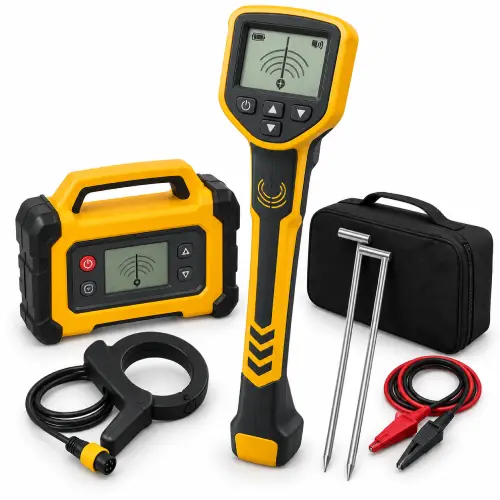
What Is a Cable Detector?
A Cable Detector is an electronic testing or locating instrument designed to help identify the presence, route or approximate position of cables. Depending on the model, the instrument may work by detecting an electrical signal, electromagnetic field or other detectable characteristics associated with a cable or service.
Cable detectors are particularly useful where electrical wiring is concealed behind walls, installed below surfaces or routed through areas where its exact position is not known.
Main Functions
A suitable Cable Detector may assist with:
- Cable route tracing
- Identification of concealed wiring
- Detection of electrical cables
- Fault-finding support
- Construction-site inspection
- Maintenance activities
- Identification of underground services
- Electrical installation work
- Renovation projects
The actual detection capability depends on the design and specifications of the selected instrument.
Cable Detector Brands We Supply
Industrial Components Corporation provides access to Cable Detector options from several brands for different professional requirements.
Metarvi Cable Detecter Supplier
As a Metarvi Cable Detecter Supplier, Industrial Components Corporation supports customers looking for cable detection and tracing equipment. The appropriate Metarvi model can be selected according to the required detection application and instrument specifications.
Waco Cable Detecter Supplier
Industrial Components Corporation is a Waco Cable Detecter Supplier, offering suitable cable detection solutions for electrical maintenance, installation and troubleshooting requirements.
Fluke Cable Detecter Supplier
As a Fluke Cable Detecter Supplier, we serve professional users requiring cable identification and tracing equipment. Different Fluke instruments are designed for different testing and locating applications, so the model should be selected according to the intended use.
Kusum Meco Cable Detecter Supplier
Industrial Components Corporation serves as a Kusum Meco Cable Detecter Supplier, providing suitable options for customers involved in electrical testing, maintenance and cable identification work.
CIE Cable Detecter Supplier
As a CIE Cable Detecter Supplier, we offer cable detection instruments for suitable electrical and engineering applications. Customers can select the appropriate model based on detection requirements and working conditions.
How Does a Cable Detector Work?
The operating principle varies between Cable Detector models. Some instruments are designed to detect signals associated with a cable, while others can work with a transmitter and receiver arrangement to trace a particular cable route.
A typical cable locating system may involve:
- Signal Generation:
A transmitter may introduce or provide a detectable signal on an appropriate cable or circuit. - Signal Detection:
A receiver identifies the associated signal in the surrounding area. - Route Tracing:
The technician can follow the detected signal to determine the approximate cable path. - Identification:
Some systems provide additional indications that can help distinguish a particular cable or circuit.
Because detection methods differ, users should follow the operating procedure supplied with the selected instrument.
Key Advantages of Using a Cable Detector
- Helps Locate Concealed Cables
A detector can assist technicians in identifying cables that are hidden behind walls, floors or other surfaces.
- Supports Safer Maintenance Planning
Knowing the approximate cable route can help technicians plan maintenance or modification work more effectively.
- Useful During Renovation
Cable detection can be particularly valuable when drilling, cutting or modifying existing structures where hidden wiring may be present.
- Saves Inspection Time
Instead of relying entirely on drawings or assumptions, technicians can use suitable detection equipment to investigate cable routes.
- Assists Troubleshooting
Some cable detection systems can help identify or trace specific circuits, making them useful during electrical fault investigation.
- Useful for Infrastructure Work
Appropriate cable locating equipment can support work where buried or concealed electrical services need to be identified before further activity.
Technical Specifications – All Brands
Cable Detector specifications vary considerably according to the brand, model and detection method. The following table shows the major parameters that should be compared.
Technical Parameter | Metarvi | Waco | Fluke | Kusum Meco | CIE |
Product Type | Cable Detector | Cable Detector | Cable Detector | Cable Detector | Cable Detector |
Detection Method | Model dependent | Model dependent | Model dependent | Model dependent | Model dependent |
Detection Application | Model dependent | Model dependent | Model dependent | Model dependent | Model dependent |
Detection Range/Depth | Model dependent | Model dependent | Model dependent | Model dependent | Model dependent |
Signal Transmitter | Model dependent | Model dependent | Model dependent | Model dependent | Model dependent |
Signal Receiver | Model dependent | Model dependent | Model dependent | Model dependent | Model dependent |
Cable Identification | Model dependent | Model dependent | Model dependent | Model dependent | Model dependent |
Visual Indication | Model dependent | Model dependent | Model dependent | Model dependent | Model dependent |
Audible Indication | Model dependent | Model dependent | Model dependent | Model dependent | Model dependent |
Display | Model dependent | Model dependent | Model dependent | Model dependent | Model dependent |
Power Supply | Battery, model dependent | Battery, model dependent | Battery, model dependent | Battery, model dependent | Battery, model dependent |
Portability | Handheld / model dependent | Handheld / model dependent | Handheld / model dependent | Handheld / model dependent | Handheld / model dependent |
Accessories | Model dependent | Model dependent | Model dependent | Model dependent | Model dependent |
Note: Exact detection depth, frequency, signal strength, accuracy, cable identification capability and accessories must be confirmed from the datasheet of the particular model. Detection performance can also vary according to cable type, installation depth, surrounding materials and environmental conditions.
Cable Detector Selection Guide
Choosing a Cable Detector should begin with the application rather than the brand name alone.
- Identify the Cable Location
Determine whether the cables are expected to be behind walls, beneath floors, underground or within an industrial installation.
- Consider Cable Type
Different detectors may be designed for particular types of electrical or communication cables. Check compatibility before purchase.
- Determine Required Detection Depth
For buried cables, the required detection depth is an important consideration. The manufacturer’s stated performance should be evaluated for the actual site conditions.
- Check Detection Method
Some systems use transmitters and receivers, while others rely on different detection principles. Select a method suitable for the application.
- Consider Identification Features
If several cables are located close together, cable identification capability may be particularly useful.
- Review Site Conditions
Concrete, metal structures, moisture, other electrical circuits and electromagnetic interference can influence detection performance.
Common Applications
Cable Detectors can be used across numerous electrical, construction and maintenance environments.
- Electrical Maintenance
Technicians can use suitable detectors to investigate concealed wiring and identify cable routes during maintenance.
- Building Renovation
Before drilling or cutting into walls and floors, cable detection can help identify potentially concealed electrical services.
- Construction Projects
Cable locating equipment can support site investigation where existing underground or concealed services may be present.
- Underground Cable Identification
Suitable cable locators can help identify the approximate route of underground electrical services.
- Industrial Plants
Factories may use cable detection equipment during equipment modification, maintenance and electrical troubleshooting.
- Telecommunications and Data Installations
Certain cable detection instruments can be suitable for identifying specified communication or signal cables, depending on their design.
- Electrical Troubleshooting
Cable tracing equipment can help technicians investigate circuit routes and connections when documentation is incomplete.
Important Benefits for Industrial Users
For industrial maintenance teams, having a suitable Cable Detector readily available can improve the initial investigation stage of electrical work.
It can help with:
- Faster cable identification
- Maintenance planning
- Route tracing
- Renovation preparation
- Electrical troubleshooting
- Site investigation
- Reduced reliance on incomplete cable drawings
- Identification of concealed services
A detector should be treated as an inspection aid, not as a guarantee that every concealed service has been identified. Appropriate site safety procedures should always be followed before drilling, excavation or electrical work.
Quality You Can Trust
A cable detector must be suitable for the particular detection task. Industrial Components Corporation focuses on helping customers compare relevant technical characteristics before selecting a product.
Important factors include:
- Detection method
- Cable compatibility
- Detection depth
- Signal strength
- Receiver sensitivity
- Transmitter functions
- Environmental conditions
- Display and indication
- Battery life
- Included accessories
- Manufacturer’s operating instructions
Proper use and periodic inspection can help maintain the reliability of the instrument.
Cable Detector Supplier in Kolkata
Industrial Components Corporation is a dependable Cable Detector supplier in Kolkata, offering cable locating and detection solutions for electrical contractors, technicians, maintenance teams and industrial organizations.
We provide options from Metarvi, Waco, Fluke, Kusum Meco and CIE, depending on model availability and application requirements.
Cable Detector Supplier in West Bengal and Bihar
Customers across West Bengal and Bihar can approach Industrial Components Corporation for Cable Detectors suitable for electrical maintenance, construction and cable-tracing applications.
Our team can help customers consider the required detection method, cable type and working environment when selecting an instrument.
Cable Detector Supplier in Odisha and Jharkhand
Industrial Components Corporation supplies Cable Detectors to customers in Odisha and Jharkhand for industrial maintenance, construction, electrical installation and troubleshooting requirements.
Cable Detector Supplier in Chhattisgarh and Assam
We also serve customers searching for a Cable Detector supplier in Chhattisgarh and Assam, supporting electrical and engineering professionals with suitable cable locating equipment.
Why Choose Industrial Components Corporation?
Industrial Components Corporation provides a convenient sourcing option for electrical measuring, testing and detection instruments.
Our Advantages
- Multiple Cable Detector brand options
- Metarvi, Waco, Fluke, Kusum Meco and CIE options
- Application-focused product guidance
- Industrial and electrical product expertise
- Support for cable tracing requirements
- Regional supply across multiple states
- Model-specific specification consideration
- Suitable solutions for maintenance and engineering teams
Infrastructure and Industrial Uses of Cable Detector
Cable detection equipment can be valuable wherever existing electrical infrastructure needs to be identified before maintenance, modification or construction work.
Typical areas include:
- Manufacturing facilities
- Electrical substations
- Industrial plants
- Commercial buildings
- Construction sites
- Engineering workshops
- Utility installations
- Residential and commercial renovation
- Underground service areas
- Infrastructure projects
- Electrical maintenance departments
Before excavation or intrusive work, cable detection should be combined with available drawings, records and appropriate site-investigation procedures rather than being relied upon as the sole method of locating services.
Customer Queries
A Cable Detector is used to help locate, trace or identify electrical cables and other compatible services, depending on the capabilities of the selected model.
Suitable models can help detect concealed wiring, but detection performance depends on cable type, installation method, depth, surrounding materials and instrument specifications.
Certain cable locating instruments are designed for underground cable tracing. The required model should be selected according to the expected cable depth and site conditions.
Industrial Components Corporation supplies options from Metarvi, Waco, Fluke, Kusum Meco and CIE, subject to product and model availability.
Consider detection method, cable type, expected detection depth, transmitter/receiver arrangement, identification features, operating environment and accessories.
No. Detection performance is affected by installation conditions and the characteristics of the cable and surrounding environment. It should be used as part of a broader site-safety and investigation procedure.
Industrial Components Corporation supplies Cable Detectors in Kolkata, West Bengal, Bihar, Odisha, Jharkhand, Chhattisgarh and Assam.
Contact Us
Looking for a reliable Cable Detector supplier in Kolkata, West Bengal, Bihar, Odisha, Jharkhand, Chhattisgarh and Assam? Contact Industrial Components Corporation for Cable Detector options from Metarvi, Waco, Fluke, Kusum Meco and CIE. Share your application, cable type, approximate installation depth and preferred brand with our team to help identify a suitable model.
